
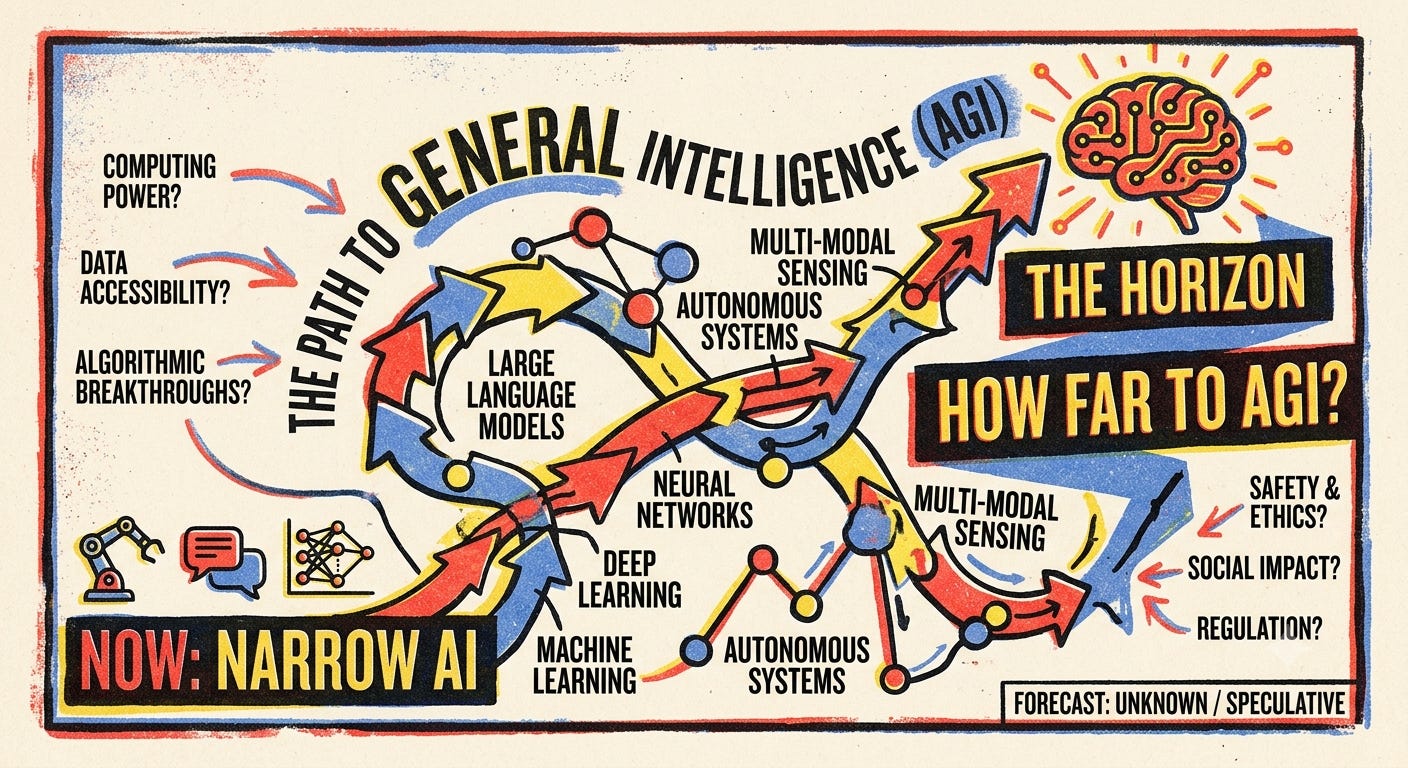
A software engineer in San Francisco assigns Claude Opus 4.6 a 12 hour coding task on a Friday afternoon and picks up the result on Monday morning. A prediction market on Metaculus puts the arrival of "general AI" at 2031, with an 80% confidence band stretching from 2027 to 2044. Dario Amodei tells Dwarkesh Patel that AGI sits one to three years out and calls the lack of public alarm "wild." Three data points, three different pictures of the same question.
The question matters in Nairobi as much as it does in Mountain View. If Amodei is right, entire categories of white collar work compress into software within a presidential term. If the Metaculus median holds, Kenyan graduates entering the workforce today have a full career before general intelligence changes the terms of employment. The gap between those two futures is enormous, and nobody selling a confident timeline actually has one.
What "AGI" Even Means
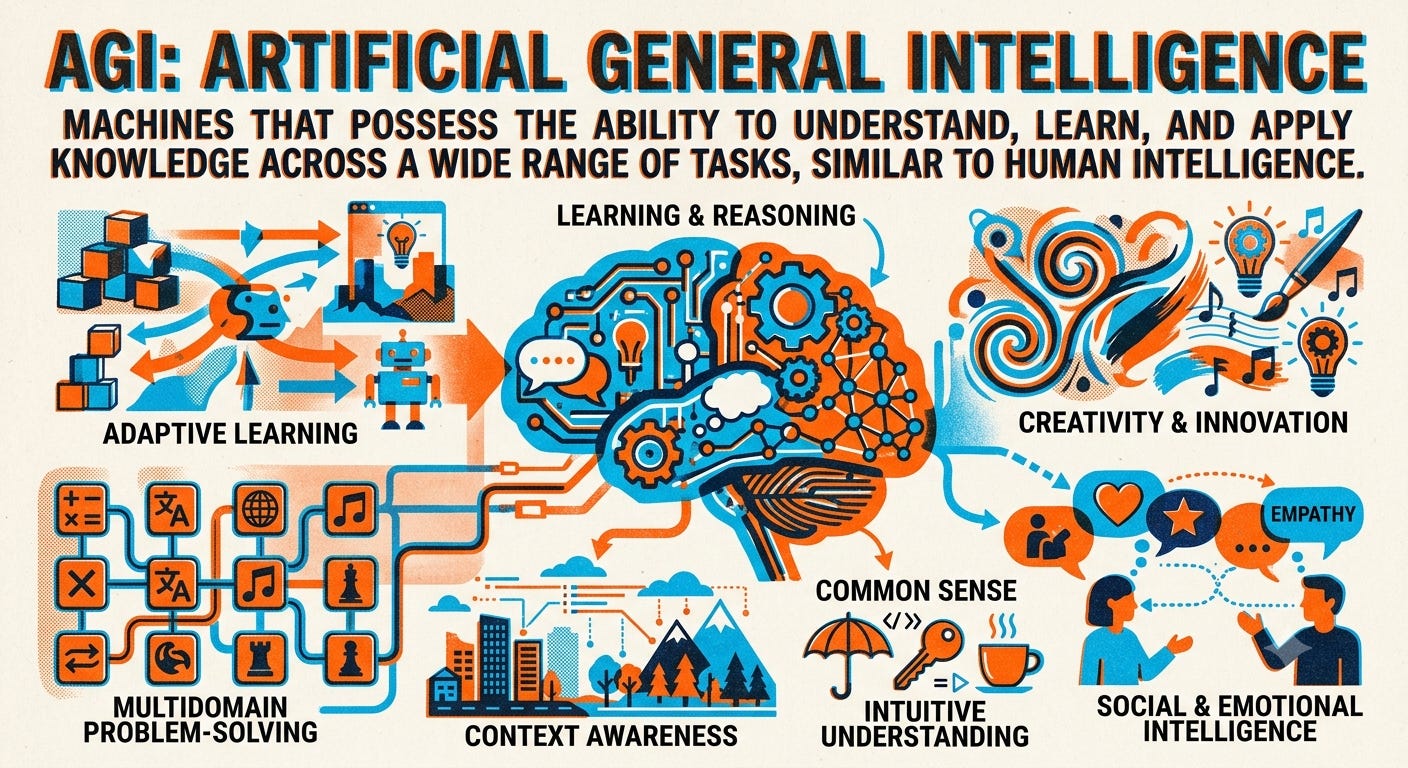
Ask five AI researchers to define artificial general intelligence and expect five different answers. Some point to a system that matches human performance across nearly every cognitive task. Others use a narrower bar: an AI that can automate most remote work at human quality, speed, and cost. Metaculus runs four separate definitional questions on its platform because a single label can't hold the concept.
Dario Amodei of Anthropic forecasts AI systems broadly better than humans at almost everything by 2026 or 2027, while Demis Hassabis of Google DeepMind splits the difference at five to ten years. Both men run frontier labs. Both have access to unreleased models. They land in different decades because they're answering different questions about what "general" requires.
This matters for anyone building a business plan around AGI arrival. A 2027 forecast for automating knowledge work is not the same claim as a 2027 forecast for a system that passes every rigorous benchmark humans can devise. Treat the two as interchangeable and you end up planning for a headline instead of a technology.
The Number Everyone Cites: Doubling Every Seven Months
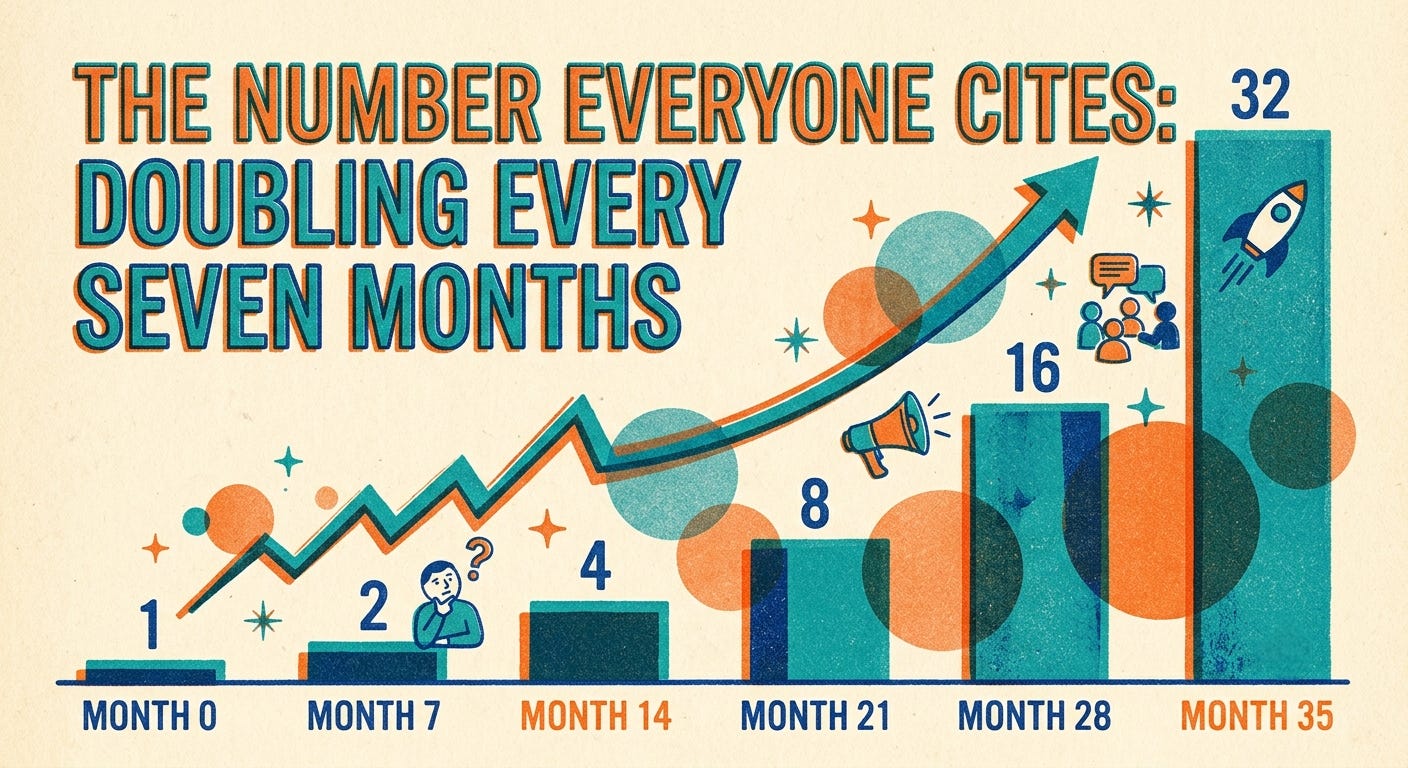
The most concrete evidence in this debate comes from METR, a nonprofit that measures how long a task an AI model can complete unsupervised, calibrated against how long the same task takes a skilled human. METR found that the length of software task an AI model can complete has been doubling roughly every seven months since 2019. GPT-2 could handle tasks that took a human two seconds. Claude 3.7 Sonnet reached 50 minutes. By early 2026, Opus 4.6 hit roughly 12 hours.
Some analysis of 2024 to 2025 data suggests the doubling rate accelerated to every four months, which would put month-long autonomous tasks within reach by 2027. Not everyone buys the acceleration story. Statistical critics have pointed out that the trend estimate depends heavily on a handful of data points at the long-task end, where success rates on 8 hour and 16 hour tasks are thin and noisy. METR itself flagged this limitation directly: measurements above 16 hours are unreliable with the current task suite.
Treat the trend as directionally real and the specific slope as contested. Either way, the gap between "AI can write a function" and "AI can run a two week project end to end" is closing, not widening.
Why Forecasters Keep Moving the Date
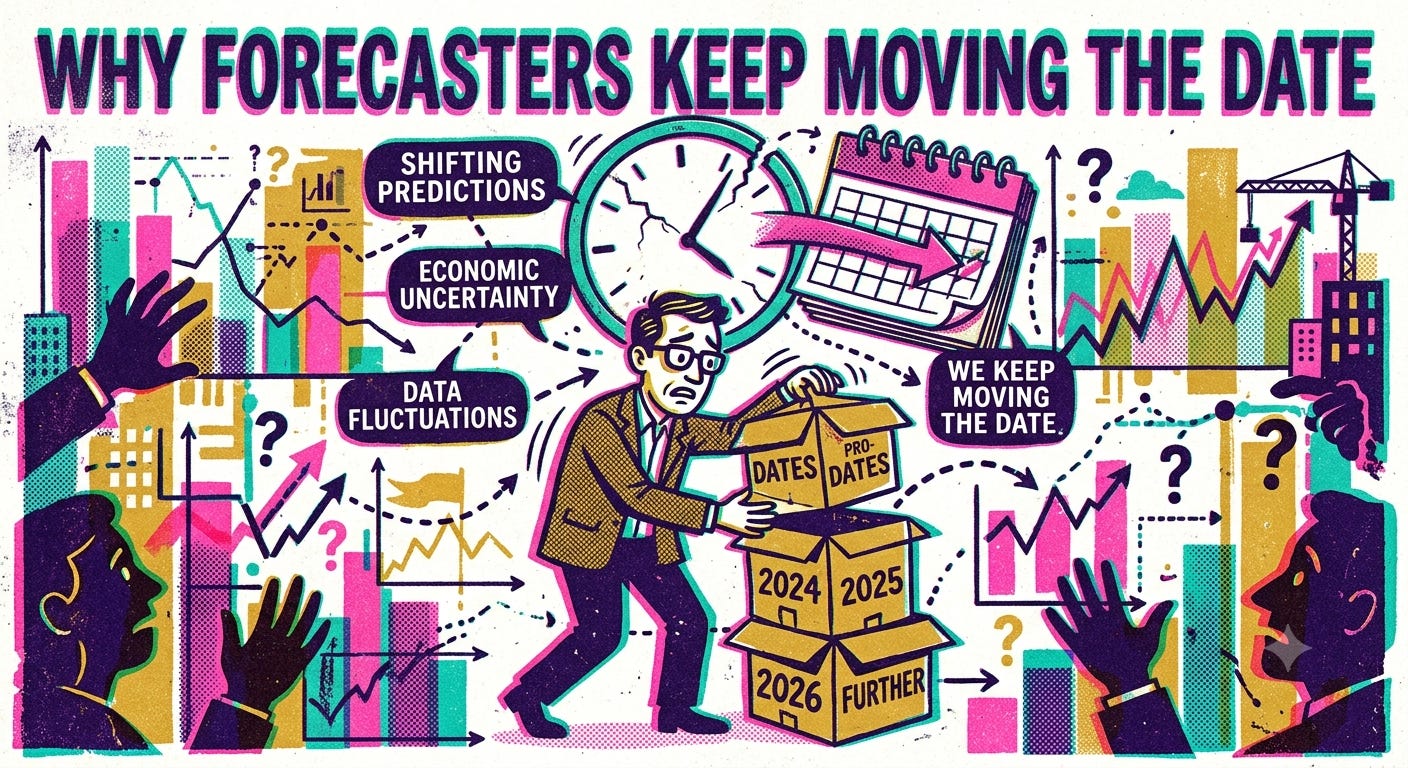
The most striking pattern in AGI forecasting isn't any single prediction. It's the direction of revision. In 2020, the Metaculus community median put AGI roughly fifty years out. By February 2026, that median had compressed to a 25% probability by 2029 and 50% by 2033.
Superforecasters at Samotsvety, a group with a verified track record on platforms like INFER, estimated a 32% probability of AGI by 2042 back in 2022. By January 2026, the same group had shifted to a 28% probability of AGI by 2030. That's over a decade of timeline compression inside four years of calendar time. Geoffrey Hinton, the Turing Award winner who helped build the deep learning field, revised his own estimate from "30 to 50 years" before 2023 to "5 to 20 years" with 50% probability within two decades.
Not everyone moved the same direction at the same time. Forecasters Daniel Kokotajlo and Eli Lifland pushed their timelines out during 2025, then pulled them back in during early 2026 as Anthropic's progress accelerated. Every person tracked who updated between January and April 2026 shortened their timeline, without exception. Whether that pattern holds through the rest of 2026 is an open question, not a settled trend.
Kenya's Regulatory Clock Is Ticking Too
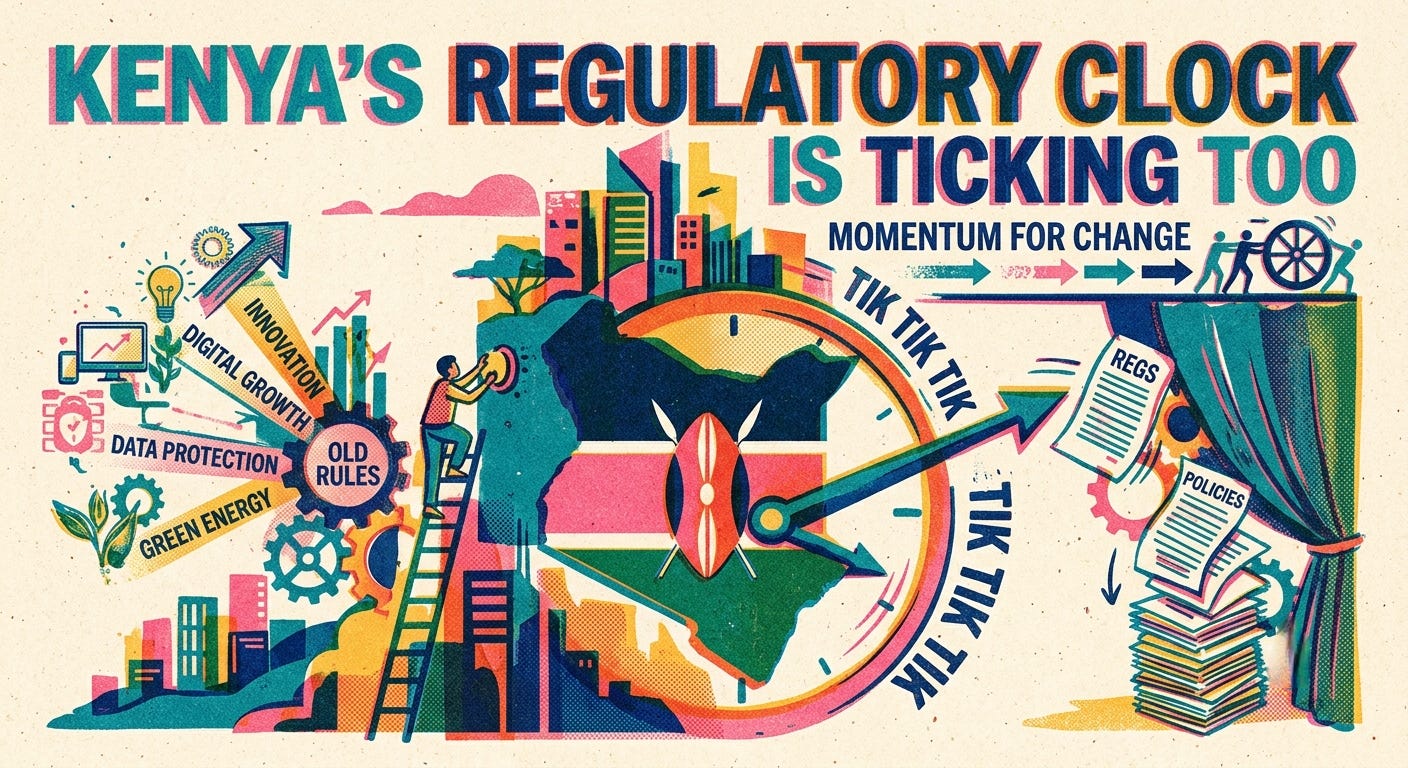
While forecasters argue over years and months, Kenya's own AI governance timeline has started moving. The National AI Strategy 2025-2030, launched on March 27, 2025, set out to address gaps in regulation, investment, and skills while positioning Kenya as an AI hub for the continent. That strategy was always meant to be a first step. The Artificial Intelligence Bill, 2026 is the graduation point the strategy promised, moving from a soft policy framework toward standalone legislation as adoption matures. The Bill borrows a risk based classification model loosely modelled on the EU AI Act, sorting systems into unacceptable, high, limited, and minimal risk categories.
Implementation on the ground tells a rougher story. By mid-2026, only around 300 of Kenya's planned digital hubs were operational, with 120 stalled in phase one, and fiber rollout sat near 10,000 kilometers against a much larger eventual target. Kenya's AI governance roadmap itself still admits design and testing standards remain under deliberation, even as officials present it internationally as evidence of responsible AI leadership.
For a Kenyan founder, the practical read is this: regulation is coming, but enforcement capacity lags the paperwork. Build compliant systems now, because the AI Bill's risk categories will apply retroactively to whatever gets deployed between now and passage. Waiting for the law to settle before thinking about data protection or model accountability is the wrong bet.
What Compressed Timelines Mean for Kenyan Developers
If METR's time horizon trend holds even at the slower seven month doubling rate, agents capable of running week-long or month-long projects without supervision arrive within the next two to three years. That has direct consequences for how Kenyan tech talent should position itself.
Coding is the leading indicator, not the exception. Anthropic's own timeline argument rests heavily on AI automating software engineering first, because code is a domain where success is verifiable and training data is abundant. A Nairobi developer competing purely on writing boilerplate faces the sharpest near-term pressure. A developer who owns the judgment calls around architecture, security review, and business context stays valuable longer.
Access remains the binding constraint, not capability. Kenyan developers have repeatedly found that the frontier models driving these timelines arrive in the region later than in the US, gated by export controls, payment infrastructure, or deliberate staged rollouts. The gap between "AGI exists somewhere" and "AGI is available to a developer in Westlands with a Safaricom line and a Visa card" could stretch months or years beyond the headline date.
Verification skills outlast generation skills. As models handle longer autonomous stretches, the bottleneck shifts from producing code to checking whether the code did the right thing. That's a skill gap Kenyan engineering programs can start closing now, ahead of the wave rather than behind it.
The Honest Bottom Line
Nobody credible claims certainty here. A combined forecast pulling together multiple prediction sources put the median AGI arrival at 2031 as of mid July 2026, with an 80% confidence range spanning 2027 to 2044. That's not a prediction. That's an admission that the range of plausible outcomes still covers three decades.
What has changed is the direction of travel. Every major tracked forecaster who moved their estimate in early 2026 moved it sooner, not later. The task lengths AI models can handle unsupervised keep growing on a consistent trend, even if the exact slope is debated. And Kenya's regulatory apparatus, however imperfectly implemented, is now writing rules for a technology whose ceiling nobody has agreed on.
Plan for arrival within the decade. Build the verification and judgment skills that survive automation. Watch the access gap as closely as the capability gap. And treat anyone who gives you a specific month with more confidence than the researchers building the systems themselves.
TL;DR
Metaculus's combined forecast puts AGI's median arrival at 2031, with an 80% confidence range of 2027 to 2044, as of July 16, 2026.
Dario Amodei has told Dwarkesh Patel that AGI sits one to three years away, one of the most aggressive timelines from any lab leader.
Demis Hassabis of DeepMind estimates five to ten years, showing how much the definition of AGI shapes the forecast.
METR's time horizon data shows the length of coding task frontier AI can complete unsupervised has doubled roughly every seven months since 2019.
Claude Opus 4.6 reached a roughly 12 hour time horizon by early 2026, up from 50 minutes for Claude 3.7 Sonnet.
Some 2024 to 2025 data suggests the doubling rate accelerated to four months, though METR flags measurements above 16 hours as unreliable with current methods.
Metaculus's community median for AGI compressed from roughly 50 years out in 2020 to a 50% probability by 2033 as of February 2026.
Samotsvety superforecasters moved from a 32% probability of AGI by 2042 in 2022 to a 28% probability by 2030 in January 2026.
Geoffrey Hinton revised his own estimate from 30 to 50 years to 5 to 20 years, with 50% probability within two decades.
Every tracked forecaster who updated their timeline between January and April 2026 moved it sooner, with no exceptions recorded.
Kenya's National AI Strategy 2025-2030 launched March 27, 2025, and the Artificial Intelligence Bill, 2026 is now moving it toward binding law.
The AI Bill adopts a four tier risk classification system modelled loosely on the EU AI Act.
Only around 300 of Kenya's planned 1,450 digital hubs were operational by mid-2026, with 120 stalled in phase one.
USD to KES trades near KSh 129.2 as of mid-July 2026, relevant for any Kenyan developer pricing access to frontier AI subscriptions.
The practical risk for Kenyan builders isn't AGI's arrival date. It's the lag between global capability and regional access to that capability.
Where do you think Kenya sits on the AGI curve: ahead of the policy wave, or still catching up to it? Share your take in the comments.

Curated by JengoAI and Claude